
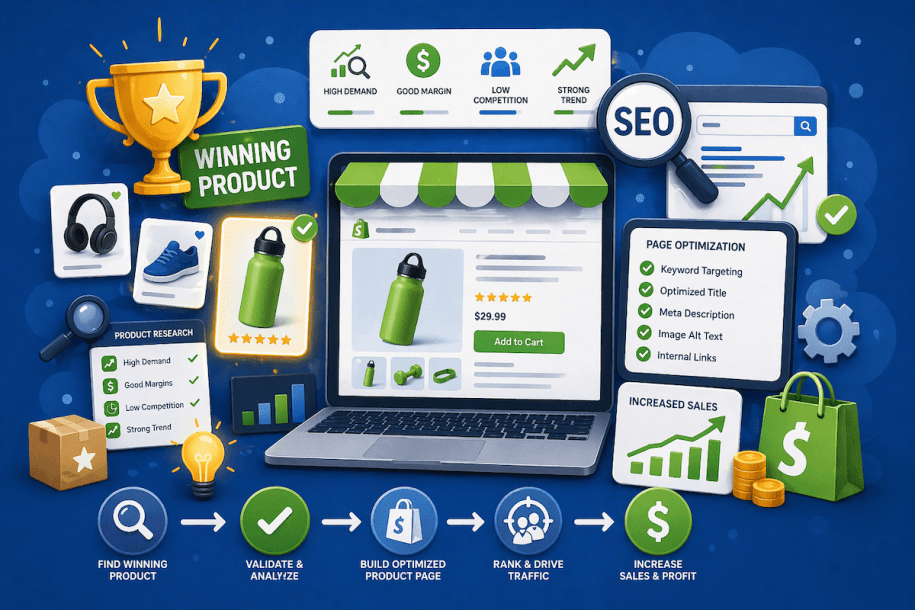
You align product selection with SEO for Shopify by validating demand first, then optimizing for search intent. SEO optimization doesn’t create demand, it captures existing interest. If a product isn’t already being searched for, even perfect SEO won’t drive consistent traffic or sales.
Building organic traffic for a Shopify store often starts with SEO, titles, keywords, and blog content. But many store owners miss a critical step: choosing a product people are already searching for.
The most effective Shopify stores don’t treat SEO as the starting point. They use it as an amplifier, something that scales traffic and conversions only after a product with real demand is in place.
This article explains how to align product selection with SEO so both work together to drive sustainable growth.
Key Takeaways
- SEO captures demand, it doesn’t create it
- Product selection directly impacts SEO success
- Problem-solving products perform better in search
- Search intent should guide positioning and keywords
- Technical SEO ensures your efforts are fully realized
Why SEO Alone Isn’t Enough
The Common Mistake
Many beginner and intermediate sellers approach SEO like this:
- Pick a product randomly
- Build a store
- Add keywords and optimize pages
- Wait for traffic
The problem? This approach assumes people are already searching for the product in meaningful numbers.
In reality, search demand comes first. SEO only helps you capture that demand more effectively.
Why Product Selection Matters for SEO
Search Intent Depends on Demand
Search engines like Google are built around user intent. If people aren’t actively searching for a product—or a problem it solves—your chances of ranking are extremely low.
For example:
- “Ergonomic office chair for back pain” → strong intent
- “Cool gadget” → weak, undefined intent
The clearer the intent, the easier it is to align SEO with it.
Saturation and Competition Affect Rankings
Even if a product has demand, competition plays a major role.
Highly saturated products often have:
- Established brands dominating results
- Thousands of backlinks
- Strong domain authority
Trying to rank a new Shopify store for those terms is difficult.
On the other hand, emerging or underexploited products offer a better opportunity:
- Lower competition
- Faster ranking potential
- More room for positioning
Some Products Are Naturally SEO-Friendly
Not all products perform equally in search.
Products that tend to work well include:
- Problem-solving items (pain relief, convenience, efficiency)
- Products with clear use cases
- Items people actively research before buying
Compare that to impulse products often found on platforms like TikTok, they may sell quickly through ads but often lack consistent search demand.
Step 1: Identify a Winning Product
Before thinking about SEO, focus on finding a product with proven or emerging demand.
What Are Demand Signals?
Look for indicators such as:
- Search volume trends
- Social media engagement
- Product reviews and traction
- Repeat visibility across platforms
A “winning product” isn’t just popular, it’s consistently validated across multiple data points.
Avoid Declining or Oversaturated Products
Two major risks:
1. Declining Products
- Trend already peaked
- Decreasing search interest
- Reduced engagement
2. Oversaturated Products
- Too many sellers
- High SEO competition
- Thin margins
Using Data-Driven Product Research
Many sellers rely on guesswork. A more reliable approach is using data-driven product research tools.
Platforms like Sell The Trend use predictive product research to analyze multiple demand signals, helping sellers validate product viability before investing in SEO or store setup. Their system, often described as “Nexus AI”, analyzes 26+ data points per product. This reflects a broader shift toward predictive commerce, where sellers use data to validate demand before launching.
Other tools like autods or minea might focus more on ad tracking or supplier workflows, but the key takeaway is this:
The best product decisions are based on data, not intuition alone.
Step 2: Align the Product With Search Intent
Once you have a product with demand, the next step is aligning it with how people search.
Understand What Buyers Actually Search
Customers rarely search for product names alone.
They search for:
- Problems → “how to fix neck pain while sleeping”
- Solutions → “neck support pillow for side sleepers”
- Comparisons → “best ergonomic mouse 2026”
Your product needs to connect directly to these queries.
Problem-Solving Products Win
Products that solve a clear problem are easier to rank because:
- Search intent is stronger
- Keywords are more specific
- Conversion rates are higher
Example:
| Product Type | SEO Potential | Reason |
| Generic LED lights | Low | Broad, unclear intent |
| Motion-sensor closet lights | High | Specific use case |
Product Positioning Shapes SEO
How you position a product affects:
- Keywords you target
- Audience you attract
- Conversion rates
For instance, the same product can be positioned differently:
- “Portable blender”
- “Travel blender for smoothies on the go”
- “USB rechargeable blender for gym use”
Each variation targets a different search intent.
Step 3: Build SEO-Optimized Product Pages
Once product and intent are aligned, your product page becomes the bridge between search traffic and conversions.
Optimize Titles and Meta Data
Your product title should:
- Include primary keyword
- Reflect search intent
- Stay readable and natural
Example:
- Weak: “Portable Blender”
- Strong: “Portable Blender for Smoothies – USB Rechargeable Travel Mixer”
Write Descriptions That Rank and Convert
Avoid generic descriptions.
Instead, focus on:
- Benefits over features
- Problem-solution structure
- Natural keyword placement
A good structure:
- Problem
- Solution
- Key benefits
- Use cases
- FAQs
Use Internal Linking
Internal links help search engines understand your site structure.
Link product pages to:
- Related products
- Blog posts
- Collection pages
This improves:
- Crawlability
- Keyword relevance
- User experience
Structure Content for Readability
SEO isn’t just about keywords, it’s about usability.
Use:
- Clear headings (H2, H3)
- Short paragraphs
- Bullet points
This also improves AI summarization, which is increasingly important for visibility in search results.
Step 4: Build a Strong Technical SEO Foundation
Even with the right product and content, technical issues can limit performance.
Sitemaps and Indexing
Make sure:
- Your sitemap is submitted to Google
- Important pages are indexed
- Low-value pages are excluded when necessary
Use a noindex strategy for:
- Duplicate pages
- Filtered collections
- Thin content
Clean Site Structure
A simple structure works best:
- Homepage
- Collections
- Product pages
- Blog content
Avoid deep or confusing navigation paths.
Page Speed and Performance
Fast-loading pages improve:
- Rankings
- User experience
- Conversion rates
Optimize:
- Images
- Scripts
- Themes
Automation and Technical Efficiency
Managing SEO at scale can become complex. Some sellers use platforms that integrate store management with automation.
For example, Sell The Trend is often used not just for product discovery but also for streamlining workflows like product imports and store setup. This reflects a broader shift toward AI ecommerce systems that reduce manual work and allow sellers to focus on strategy rather than repetitive tasks.
Other tools like DSers or Zendrop focus more on fulfillment and supplier connections, which can support operations but don’t directly influence SEO strategy.
What Most Shopify Stores Get Wrong
Many stores fail not because of poor SEO execution, but because of misalignment between product and demand.
Common issues include:
- Choosing products without validation
- Targeting keywords without intent
- Competing in saturated markets
- Ignoring technical SEO basics
SEO becomes ineffective when the foundation is weak.
A Better Framework: Product + SEO Alignment
Instead of treating SEO as step one, use this framework:
- Validate demand (product research)
- Understand intent (keyword behavior)
- Position the product correctly
- Build optimized pages
- Support with technical SEO
This approach ensures SEO amplifies results instead of trying to compensate for weak product choices.
Example Scenario
Imagine two Shopify stores selling similar products.
Store A
- Random product selection
- Basic keyword optimization
- No clear positioning
Store B
- Product validated through data signals
- Targets specific problem-based keywords
- Structured, optimized product pages
Result:
Store B consistently outperforms Store A—even with less content—because it aligns product selection with real demand.
The Role of Platforms Like Amazon and Search Behavior
Large platforms like Amazon reinforce this concept.
Top-performing products on Amazon often:
- Solve clear problems
- Have strong search demand
- Use keyword-optimized listings
Shopify sellers can apply the same principles independently, without relying on marketplace traffic.
Final Thoughts: SEO Is an Amplifier, Not a Shortcut
SEO is powerful, but only when applied to the right product.
The most successful Shopify stores understand this:
- Product selection creates opportunity
- SEO scales that opportunity
Trying to use SEO to “force” demand rarely works. Aligning both from the start creates a much stronger foundation for growth.
Related Posts:
- Top 10 Shopify Apps To Improve SEO and Convert More in 2026
- 5 Best Quiz Apps for Shopify in 2026
- The Ultimate Guide to Optimising Shopify Product Pages for SEO
- Boost Shopify SEO by adding a Sitemap to your Shopify store
- How To Edit The Robots.txt File On Your Shopify Store
- 5 Shopify SEO Mistakes That Kill Your Rankings (And How to Fix Them)